Archive
Big Brother – A Dissection of (Not So) Good Community

Looking for "true community?" Watch reality tv shows like Big Brother and do the opposite!
The subject of “community” has been on my radar lately. A couple of weeks ago, the sermon at church was on community. I am also starting two new community groups – one that I will be leading and another in which I am participating (a mentoring group for community group leaders). When I look up community in the dictionary, four of the definitions really stick out to me:
- “A social group of any size whose members reside in a specific locality, share government, and often have a common cultural and historical heritage.”
- “A social, religious, occupational, or other group sharing common characteristics or interests and perceived or perceiving itself as distinct in some respect from the larger society within which it exists (usually preceded by the): the business community; the community of scholars.”
- “A group of men or women leading a common life according to a rule.”
- “Similar character; agreement; identity: community of interests.”
One of my latest guilty pleasures is the reality television show Big Brother. If you’ve never watched the show, it’s basically a group of people whom have never met and they have to live in a house together under the watchful eye of “big brother” (the American public). Each week there is a competition that determines who becomes the “head of household” and that person has to nominate two other residents to be considered for eviction. Residents then compete in another competition for “power of veto” and whomever wins this competition is able to veto one of the nominations or keep them as is. At the end of the week, all house guests must vote to evict one of the people who ends up on the chopping block. Once the competition is down to two people, the previous eliminated house guests vote on which of the remaining two will receive an enormous amount of money.
Needless to say, this show is a VERY bad example of how a community should be:
- Individuals on the show form alliances against one another – in community you must be willing to work together as one unit.
- There is a lot of back-stabbing that occurs on Big Brother – members of community should not turn on each other.
- Big Brother contestants are caught frequently calling one another names – those involved in community should encourage one another and not embarrass or put down others in the group.
- Greed seems to be a common theme on Big Brother – those in community want to see everyone succeed in the group and actively celebrate those times with them.
If your “community” were to be filmed for a reality show, would it be like Big Brother?
Photo Credit: By Elaine Ashton
Share this:

“Every Single Man’s Battle” Has The Best Of Intentions
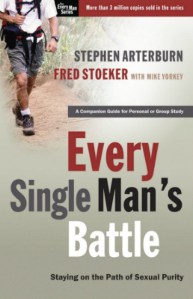
Photo Credit: By Christianbook.com
About a year ago, I read “Every Man’s Battle” by Stephen Arterburn and Fred Stoeker with Mike Yorkey. I read the book with six other guys in a single men’s small group through my church. The overall message was much appreciated, but we found out the book was geared more toward married men. When I found out about “Every Single Man’s Battle” (by the same authors) I was very excited, that was until I actually read the book. To my dismay, I was disappointed for a few reasons.
- “Every Single Man’s Battle” constantly refers to “Every Man’s Battle.” What gets me is there wasn’t a whole lot of information from that book that was geared toward single men. They should have just taken what little information that was for single men in “Every Man’s Battle” and just put the information in “Every Single Man’s Battle” instead of saying “read chapters 1-5 of Every Man’s Battle.” It’s like the sole purpose they did this was to sell more books and I have a big problem with that.
- The author’s writing style was a little bothersome as well. Everything was “you need to do…” or “you should…” which comes across as if the authors were not single men, but married men who are not currently experiencing the whole issues trying to be a sexually pure single adult male. I would have liked it a lot more if the authors changed the wording to “we as single Christian men should…” or “we should…” that way it doesn’t come across like the authors have no idea what single men are going through or like they don’t sympathize for them.
- This book is better suited as a small group study curriculum, otherwise it is a very difficult read.
The message of the book is a good one that is definitely needed for all single Christian men and I found several take away items including:
- “Actually, sexual impurity is a series of bad decisions on our part – as a result of immature character – and deliverance won’t deliver you into instant maturity. Character work needs to be done.”
- Our sexuality is not just about obeying God’s commands but also a way to honor our relationship with Him.
- “When you are tempted, He will also provide a way out so that you can stand up under it.” – 1 Corinthians 10:13
- “Being about our Father’s business is our rite of passage into manhood.”
- Single men should not live alone, but have at least one male roommate to help provide accountability in the area of sexual temptation.
I definitely recommend this book (with the above disclaimers) and even though it is a challenge at times to abide by this, the long term rewards are well worth it.
Share this:

Pretzels, Distractions, and Leadership

Anything can be a distraction for a leader.
I love being an uncle. My nieces and nephews are constantly teaching me new things through their innocent, child-like eyes. The other day I called my parents to ask them something and my two year old nephew was at their house. My mother put me on speaker phone so my nephew could talk to me. He said “Hey Uncle Scott!” and then I asked him how he was doing…absolute silence. It turned out he was distracted by pretzels. At the end of my call, I told my parents that I would talk to them later, suddenly my nephew came back to the phone and said “Hey!” again. The little tyke then proceeded to go back to the pretzels.
There are so many things in life that can distract us, much like my nephew’s pretzels. These distractions may ordinarily be something good, but they can take us away from doing what we need to do or doing it to the best of our ability. Your distraction may not be pretzels – it may be a person, circumstances, money, or any number of things. As a leader, it can be difficult at times because you are not only trying to take care of yourself and grow personally and professionally, but you are also responsible for doing the same for others. When you find yourself going through times of distraction, find a trusted friend or mentor with whom you can share these struggles. Having someone who knows what you are going through makes it easier to focus on the right things.
How do you combat distractions as a leader?
Photo Credit: By Dottie Mae
Share this:

When I Grow Up…

"When I grow up I want to be a cartoonist!"
When you were a child, you probably got the “What do you want to be when you grow up?” question from the adults around you. We had hopes and dreams of becoming something cool and exciting – a rock star, a policeman, a fireman, or even a super hero. The logic of a child is just priceless. I told everyone who asked me that I wanted to be a cartoonist because (and I quote) “Cartoonists don’t have to wear a tie to work.” It didn’t matter that I had no drawing ability whatsoever, I had made my mind up and was going to be a cartoonist.
As we grow up, we realize how humorous those thoughts of our future career were and how realistic we need to be as adults. This weekend, I went to my high school reunion and several people had changed in appearance, but no one shared of their adventures as a super hero (or even a cartoonist). Most of my former classmates are now parents, teachers, police officers, or work for the government. How did we make such drastic changes in our career choices?
I was talking with one of my mentors last week and he shared with me a list that has helped him with his career choices. He said that you need to constantly be asking yourself the following questions:
- What do you want people to say about you?
- What is it about your job (or previous jobs) that you love?
- What do you want your ministry to be/look like in 20 years?
- What are your passions?
- When have you been in the zone?
- When did you experience greatest success? Failure?
- Where have you had the biggest impact? Least?
- In what do you take pride? Of what are ashamed?
What words of wisdom have others shared with you that have helped you make big decisions (like career choice)?
Photo Credit: By Devon Weller
Share this:

Fear in Leadership

Photo Credit: By LeAnn Leagans
“Decide that you want it more than you are afraid of it.”
– Bill Cosby
As a leader, fear can often be a motivator to help us grow. You have a choice as a leader – you can stay where you are and let fear get the best of you or you can overcome fear and do new things you have never imagined possible. When you choose the first option, you often look back and wonder what could have been and end up living a life of regret. Choosing the second option may be difficult, but in the long run it’s worth it.
What steps can you take to help overcome fear as a leader?
- Surround yourself with like-minded people who will encourage and cheer you on in times of fear.
- Focus on what will happen once you make it past the fear, not the process of going through the fear itself.
- Force yourself to do it – make yourself think there are no other options.
I experienced this first hand over the weekend. I had the amazing experience of going on a leadership retreat at Callaway Gardens. During lunch they announced that everyone needed to look under their chair as one table would win a prize. Our table ended up winning the prize and it was free tickets to the ropes course and zip lines at the gardens. One minor problem – I am terrified of heights! Even though we were harnessed in, I was still afraid that I was going to fall and seriously injure myself. I had twelve other people on the course with me that helped encourage me and let me know that not only was I going to be okay, but I was going to be able to complete the course and look back on the experience as a major accomplishment.
How do you overcome fear as a leader?
Share this:

Choose “Chosen” As Your Next Read
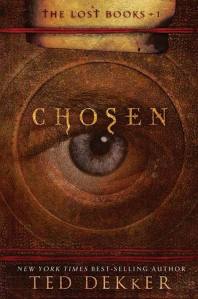
Photo Courtesy of Ebay
Ted Dekker is one of my favorite authors. I first discovered him by reading his book Thr3e and was immediately hooked. Several of his books have the good versus evil vibe to them and Chosen is no different. The first book in the young adult series introduces us to Johnis, Billos, Darsal, and Silvie – four teenagers who are chosen to lead the Forest Guard against the evil forces of the Horde. Thomas Hunter (supreme commander of the Forest Guard) selects these four individuals who are 16-18 years of age to find and bring back to him four large catalina cacti to prove they are worthy of him choosing them.
Along the journey they run into several roadblocks created by the Horde and the Shataiki bats. Johnis learns that he is responsible for finding the seven books of history and convincing his other three companions to help him with the task of which Thomas Hunter did not inform him. Will they return with the cacti? Will they find all seven books of history before it is too late? There are six books in this particular series (The Lost Books – consisting of Chosen, Infidel, Renegade, Chaos, Lunatic, and Elyon), but they are also a of part of the Circle Trilogy (Black, Red, and White). The Lost Book series fills in the fifteen missing years between Black and Red, but you can read either series before the other.
The book was an easy read that I thoroughly enjoyed. There is a little violence, but there is no foul language so it would be a good book for parents to let their preteen or teen read. It has sort of Lord of The Rings meets The Matrix kind of feel to it. I highly recommend Chosen and I’m looking forward to reading further into the series.
Share this:

Waiting Is The Hardest Part…
This is something I wrote back in October 2007, but it is still very pertinent today. Enjoy!
Wait, wait on You. My hands are tied and I’m broken in two. No sense trying to wear Your crown. You are King so I lay it down. Wait, wait on You. My will is dead and I’m black and blue. You know best and You are true. Give me strength to trust in You and wait.
-“Wait” written and performed by Todd Fields on his 2000 release, Now For Then

Waiting is never easy!
In a world of minute rice, instant coffee, and microwave popcorn we are called to “Be still before the Lord and wait patiently for Him.” (Psalm 37:7a) More often than not, I have found myself crying out to God, “Why?!?!” Patience is not (and will probably never be) one of my spiritual gifts. I want things to happen in my timing or not at all… I hate to wait.
Isaiah 30:18 tells us, “Yet the Lord longs to be gracious to you; He rises to show you compassion. For the Lord is a God of justice. Blessed are all who wait for Him!” We can be blessed if we are willing to wait, but I have to admit that quite frequently I would rather see things resolved immediately than to have to wait for a blessing that may not happen when I think it should. When I question God about the “hold-ups” that occur in my life, I feel like Jesus is answering me directly (instead of His disciples) in Matthew 17:20a when He replies, “Because you have so little faith.”
When I examine my faith, I have to know that true faith is “…being sure of what we hope for and certain of what we do not see.” (Hebrews 11:1) If I can see something, I know I can depend on it and place my faith in it. When it comes to an unseen God, sometimes (more than I would like to admit) I am very reluctant with my faith. Often it takes Him showing me that “We live by faith, not by sight.” (2 Corinthians 5:7) Other times it takes Him giving me what I want like a spoiled brat so that I can truly see that I do not know what is best for me after all.
Every time I hear James 1:4 “Perseverance must finish its work so that you can be mature and complete, not lacking anything,” I am reminded of the road trips and vacations that I took with my family as a child. Between me and my two younger brothers, one of us would frequently be asking, “Are we there yet?” I often find myself asking God the same thing. “Am I there yet? Am I complete? Have I matured? Have I persevered enough?”
Just like the family road trips, the destination gives us something to look forward to upon our arrival. “But those who hope in the Lord will renew their strength. They will soar on wings like eagles; they will run and not grow weary, they will walk and not faint.” (Isaiah 40:31) Renewed strength, the ability to run and not get weary, and the ability to walk and not faint are far better than a week at the beach, the mountains, or even Grandma’s house! (Sorry Grandma!) I challenge you (as well as myself) to continue to ask Him “Am I there yet?” and if the answer is “No” then how are you preparing yourself for the time Christ brings you there?
Photo Credit: By Josep Ma. Rosell
Share this:

Who Am I Again?!

How do you determine your true identity?
The other night I had a strange dream. In my dream, I was in the hospital with severe amnesia. There were people everywhere in my hospital room and I would ask each of them the same question. “Who am I?!” The first person responded with “You are an older brother – you have two younger brothers.” The next person responded, “You are an uncle – you have two nieces and two nephews.” One of the last people I asked told me, “You are a blogger – you write a blog.” I was really frustrated because no one really answered my question.
This dream was very telling, because I am going through a “loss of identity” period of sorts in my life right now. Men tend to find their identity in their job. When you first meet someone, they typically ask what you do for a living. It’s been a rough time because in this sense, I don’t really feel like I know who I am any more. When you go through a period like this in your life, you tend to start comparing yourself to others in a negative light – “Why can’t I look more like <insert person’s name here>?!” or “Why can’t I be more successful like <insert person’s name here>?!” This can be a dangerous path as we are unique individuals and no one else should be seen as our measuring stick as to who we should be or what we should do.
Have you ever gone through a period like this? What did you do to get out of it?
Photo credit: By SMJJP
Share this:

Rejecting Rejection

Rejections stinks!
When most people hear the word “reject” they think of the negative – unfit, not up to a certain standard, not good enough, or something with problems. Rejection comes in many forms, but most people must deal with it some time during their life. More often than not, you hear about people experiencing rejection in relationships or when looking for a job. No matter how you define it, rejection stinks.
If you are looking for a job, it can be hard not to take rejection personally. You send out resumes, talk to recruiters, go on interviews, and then play the “waiting game.” Those lucky enough to get a letter or e-mail from a company receive the “thank you for interest in our company, but we have decided to go with other candidates at this time.” How do you keep from asking yourself if it had anything to do with you personally? Insecurities can hit full force if you let them, but remember it might not even be you.
A while back, I asked out a girl in whom I was interested. She turned me down. It was a painful time where I kept questioning why she said no. Was it me? Was it her? Was it bad timing? Not only was I driving myself crazy asking questions, but I was asking one of my good friends these same questions driving him crazy as well.
I guess the real question is does it make any difference if you know why you were rejected? What would you do with this information? Will you dwell on it or will you use it to improve yourself?
Photo Credit: By comedy_nose
Share this:

Leadership Elements
 Last Thursday, I completed a four week workshop on leadership called “Leadership Elements.” (Thank you Mark Shull for recommending it!) Each of the four weeks focused on a different topic regarding being a leader. What is so great about this information is it can be used in various different environments – in the work place, at church, or even within your group of friends. Here are just a few of the “take-aways” that I learned.
- Influence, not position is what allows us to lead people.
- Influence is always in motion.
- Fair or unfair, we are often judged on the perception of our leadership, not the reality of our leadership.
- Influence comes from who you are, not just what you do.
- Leadership begins with character and ends with influence.
- Competence might make you a leader, but character gives you influence.
- People might not always listen, but they never fail to imitate.
- If you don’t know where you are, you can’t get from there to where you need to be.
- Self-awareness helps prevent hypocrisy.
- You can’t lead others past where you are.
- Self-awareness leads to compassion for others.
- A person who doesn’t have an awareness of their shortcomings comes across as pity.
Share this:


 Scott Couey